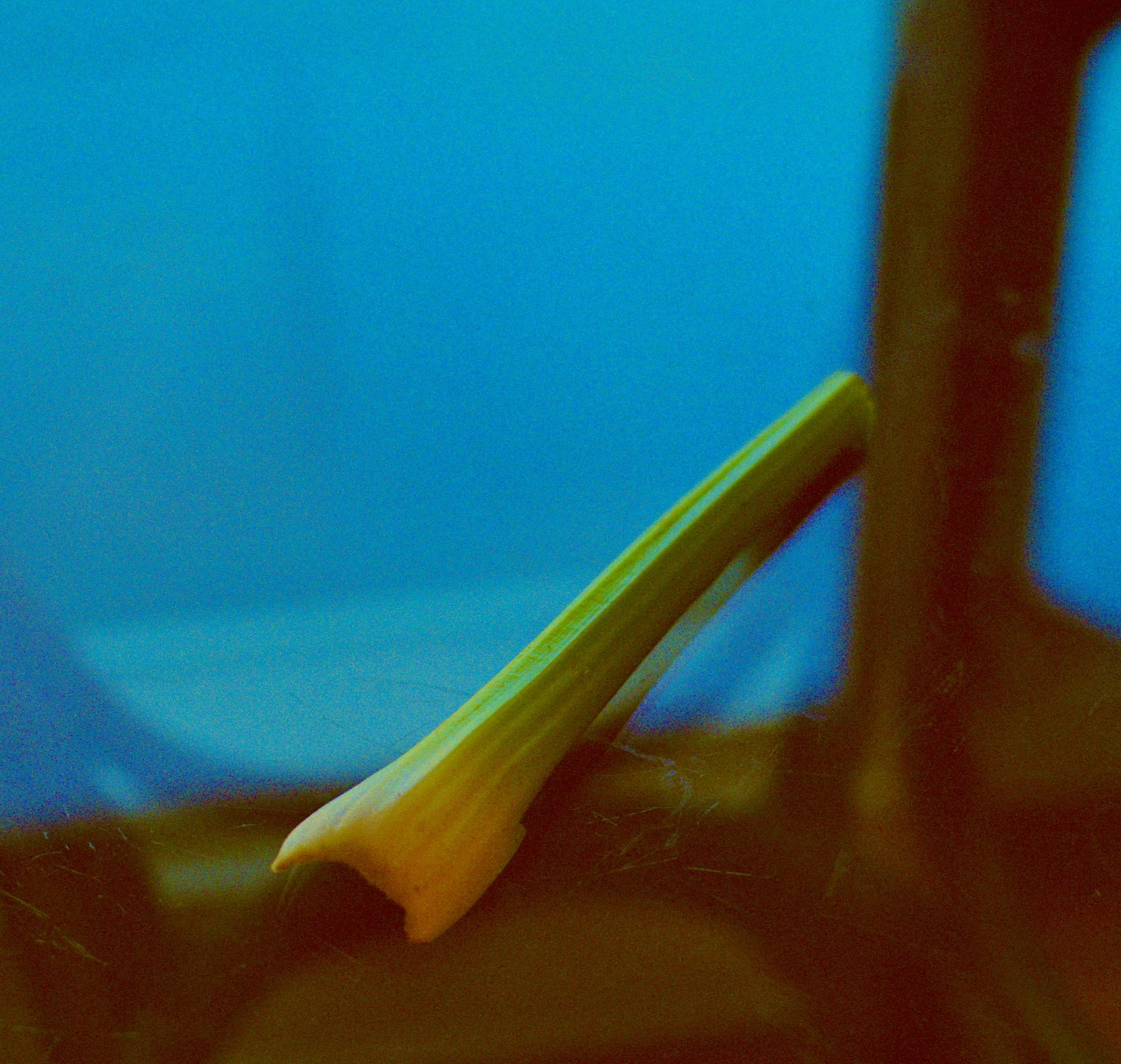
Celery is too big
Sure, celery is a superfood. But it does not need to be so super big.
Most weeks we need a rib or two—snapped cleanly, dropped in with the onions for a bolognese or risotto. And yet at the market we’re confronted with something arboreal. A green, ribbed structure that barely fits in the basket. Less vegetable, more architectural installation.
Botanically, celery (Apium graveolens) belongs to the Apiaceae family, alongside carrots, parsley, parsnips, fennel, celeriac—and, oddly, cumin. The celery most of us encounter is the green Pascal variety, selectively bred for size and crunch. Red and golden cultivars still exist, smaller and softer, with subtler flavour profiles, but they’ve been largely bred out in favour of spectacle.
And for all that basket realestate I’m really only getting 95% water. Celery earns its superfood status less for what it contains than for how it behaves. At roughly 95% water, it delivers volume, crunch, and satiety with minimal caloric load. Its fibre is mostly insoluble—supporting bowel regularity without heavy fermentation—making it comparatively gentle on the gut. It contains flavonoids like apigenin and luteolin, linked to anti-inflammatory and calming effects, alongside potassium and trace sodium that support hydration without sugar or glycaemic impact. Crucially, celery does not spike blood glucose or light up reward pathways. It supports the body quietly. In a food landscape defined by excess, its restraint is its strength.
Modern celery bunches commonly weigh between 800 grams and 1.2 kilograms¹. A single head may contain twelve to sixteen ribs, often thirty to forty centimetres long², fused at a dense white base that feels more architectural than culinary. This is not abundance. It’s a scale error.
This isn’t about food-waste guilt. It’s about mismatch. The body does not move in bulk; it moves in portions. Celery is mostly structure—about 1.6–2 grams of fibre per 100 grams³. It sweeps. It drags. It does not charm. Which is fine. Not everything needs to.
An obnoxious amount may explain why people juice it—not because celery juice is a silver bullet, but because we need to get rid of it. The guilt of a limp bunch dissolving in the crisper is real.
From a gut perspective, thirty to sixty grams per sitting is plenty. One rib weighs roughly forty to fifty grams⁴. Two ribs deliver about three grams of fibre. A full bunch contains twenty grams or more—meant to be distributed across days, not purchased aspirationally on a Tuesday.
Celery is sold as a display object, not a physiological one. Bigger looks fresher. Bigger looks like value. Bigger photographs well under misted lights. The supermarket trades in abundance. The body trades in moderation.
So snap a few ribs off. Remove the dense basal head immediately and reclaim fifteen percent of your fridge space. The half-bunch wrapped in microplastic isn’t the answer either. Don’t give me half—just make the whole thing smaller.
Celery does not need to be exciting. It needs to be manageable.
A rib. A nudge. Not a campaign.
References
Encyclopaedia Britannica. Celery (Apium graveolens): botanical description, varieties, and commercial forms.
Wikipedia. Apium graveolens: morphology, rib structure, and cultivated forms.
United States Department of Agriculture (USDA). FoodData Central: Celery, raw, nutritional composition per 100 g.
Fresh produce wholesaler specifications. Average celery rib mass and dimensional standards in commercial supply chains.
This article is informational and cultural in nature and does not constitute medical advice. Individual fibre tolerance varies.